






The loss of children is the stuff of nightmare. This loss can be intensely intimate: a child dies and a small family feels indescribable sorrow. Sometimes the loss can be national, even universal. I can still remember my incomprehension at the Aberfan disaster of 1966 where 116 children and 28 adults died, when a school was engulfed by the tidal wave of a Welsh coalmine’s slurry mountain. Sometimes the loss happens before birth. I am an only child, but my mother had to endure many miscarriages before I was born. What if some of my siblings had survived? Would this page have been written? Another kind of loss is when a child simply vanishes, probably taken. Madeleine McCann has still not been found. A couple face emotional annihilation when their child disappears in Ian McEwan’s novel ‘The Child in Time.’
To assuage grief many of us turn to prayer or to poetry or to music. Some creative artists face grief head on – Mahler in his ‘Kindertotenlieder’ wrote an elegy to his dead brother Ernst and then had to mourn his daughter Maria three years after the work completion. In ‘Die Frau Ohne Schatten’ (‘The Woman Without a Shadow’) Richard Strauss introduces the voices of unborn children who try to persuade the Dyer’s wife not to relinquish her chance of becoming a mother.
Sometimes children are killed at school not by natural forces as in Aberfan, but by highly disturbed maniacs who are driven by the darkest of forces to destroy the most innocent. The Dunblane massacre of 1996, where a lone gunman shot dead sixteen children and their primary school teacher, sent profound shock waves far beyond Scotland where the tragedy occurred. The USA, where ownership of firearms is relatively commonplace, has suffered more than any other country in this regard, and I am today considering two works by
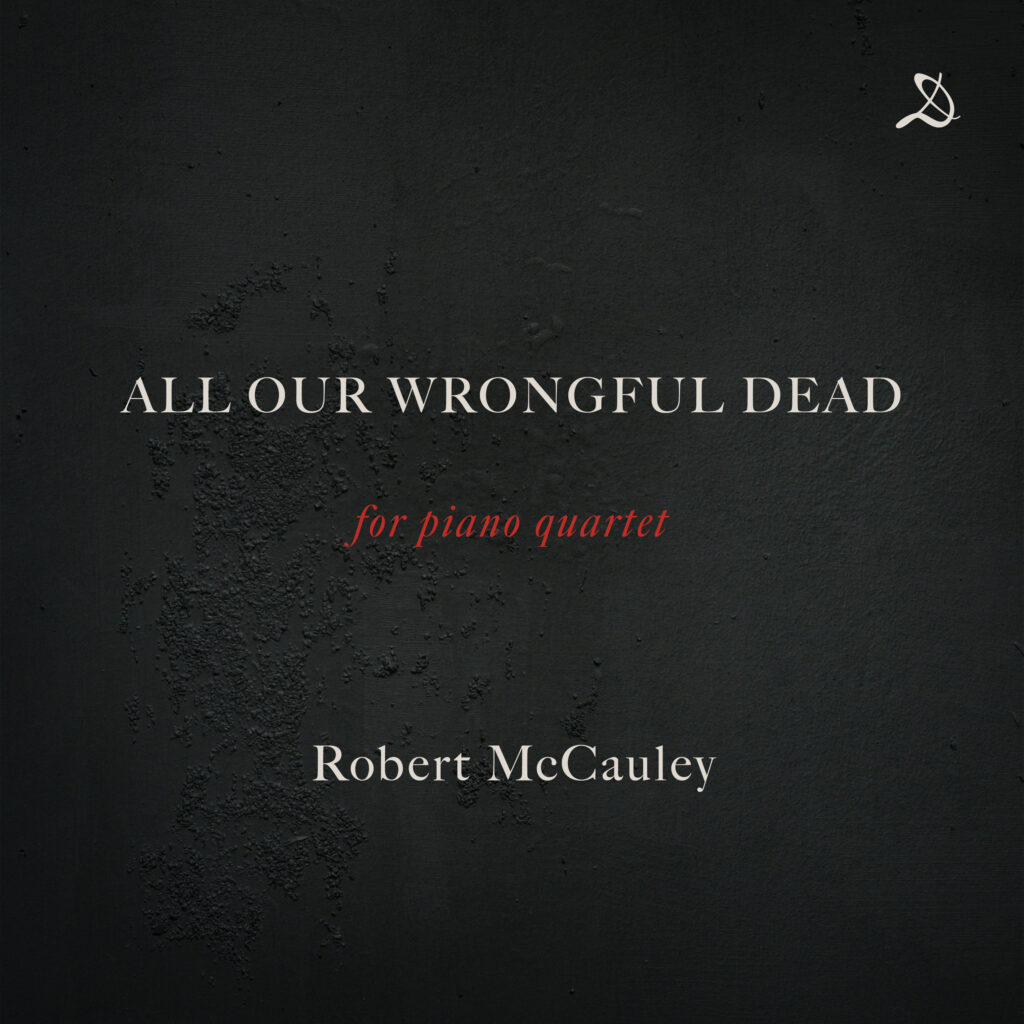
American composer Robert McCauley responding to the death of children and adults, victims of the terrible whims of the most evil. The first piece, ALL OUR WRONGFUL DEAD is written for piano quartet, and I am grateful to Metier Records, who have produced the world premiere recording, for the following programme note:
ALL OUR WRONGFUL DEAD, a large-scale piece for violin, viola, cello, and piano by composer Robert McCauley, on digital EP. Written in 2017, the work was a response to the mass shootings at Sandy Hook Elementary School in Newtown, Connecticut, in December 2012, Emanuel African Methodist Episcopal Church in Charleston, South Carolina, in June 2015, and the Pulse nightclub in Orlando, Florida, in June 2016, as well as other atrocities. The young performers are Katherine Butler (violin), Zev Malina (piano), Sebastian Berofsky (cello), and Molly Pope (viola).
Moved by the senseless massacres of innocent people by lone gunmen, McCauley needed to write music to express his sadness and horror at these events, a melodic, emotional, and powerful classical work to help us connect with the difficult feelings. … outrage … anguish … again and again, the title of the first movement, refers to the seeming perpetual cycle of sudden violence, national shock, elected leader’s non-action, and gradual amnesia until the next attack comes. The rich melodies and harmonies of this movement are based on the first six notes of Robert Schumann’s Aufschwung from Fantasiestücke, Op. 12, heavily influenced by Arvo Pärt’s Symphony No. 3. However, McCauley introduces modulations in phrases, sudden changes of texture and dynamics, and other unexpected surprises to create a “musical section-silence” structure to keep the listener purposely off balance, just as life has been kept off balance with lulls of safety followed by atrocity.
eight fervent prayers for peace is a series of variations on an original Agnus Dei (O Lamb of God) McCauley wrote for a church. The music is beautifully tender and peaceful, with a reassuring stillness after the dramatic and unsettling first movement.
The music of ‘outrage … anguish … again and again’ is often opulent and beautiful, but can also be remorseless and cruel. We are confronted with the naked pain of loss, and any comfort is only momentary. Eight fervent prayers for peace offers a series of naked supplications that may or may not be answered. Our salvation is in our hands. If we turn from violence and hatred, then our own personal Christ might be allowed to descend from his cross. McCauley’s work is very recognisably in the great line of musical religious meditation stretching from Hildegarde of Bingen, through Bach’s Passions, Biber’s ‘Biblical Sonatas’, Hadyn’s ‘Seven Last Words from the Cross’, Beethoven’s Late Quartets, Gorecki, Pärt and John Tavener. This profound, disturbing work (brilliantly performed on this recording) deserves the very widest circulation. It will be available for streaming on November 6, 2026, from Diversions.