








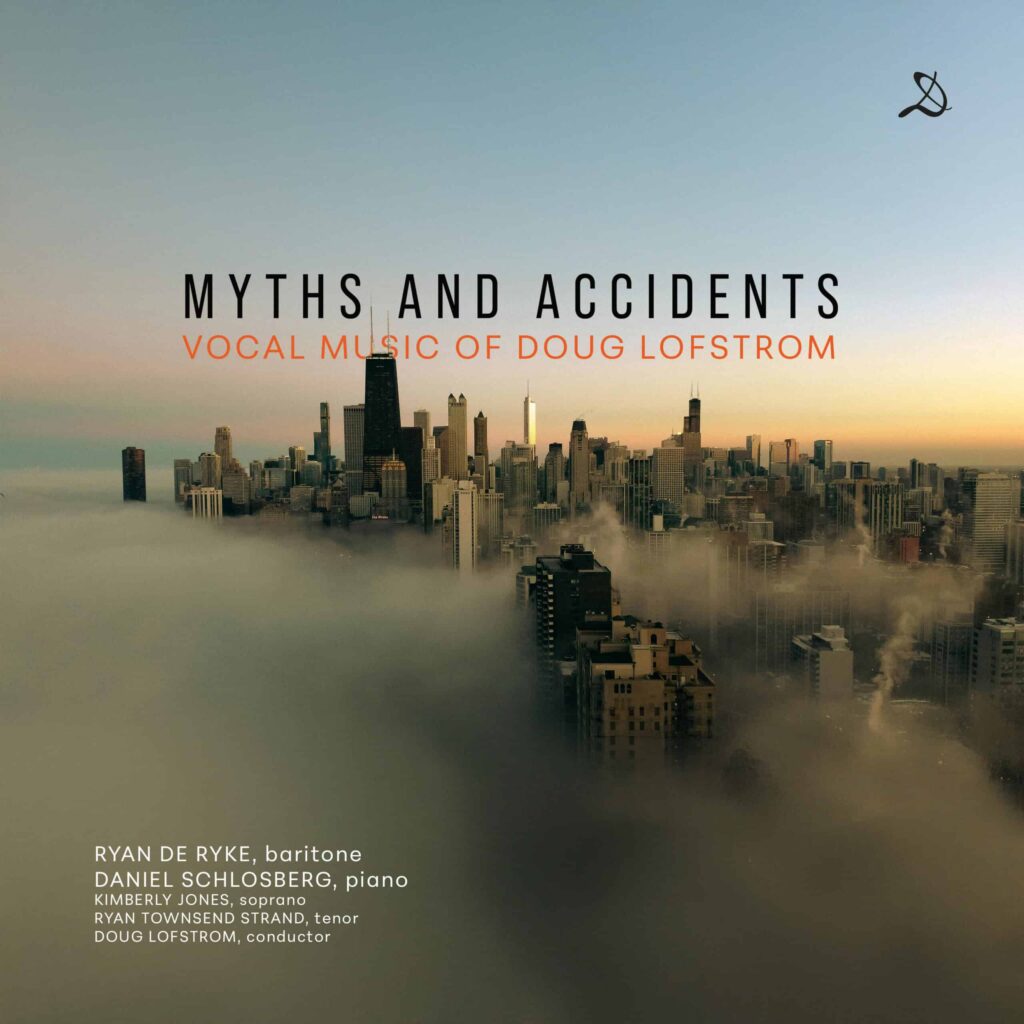
Entitled Myths and Accidents, this Diversions disc introduces the music of Doug Lofstrom (born 1949) to Fanfare. Active since the 1970s as both bassist and composer in genres such as jazz, folk, music theater, and symphonic music, Lofstrom’s music is capable of a broad range of reference while offering a broad approachability.
Once upon a time, baritone Ryan De Ryke (who features throughout) and pianist Daniel Schoenberg gave a demonstration of song at Lofstrom’s composition class at Columbia College, Chicago; this event began a long collaboration, evidence of which is certainly right here.
The disc opens with a selection of scenes from the opera Two Soldiers, though, in which De Ryke is joined by two other singers. This stage work was the composer’s first collaboration with Al Day, and dates from 1989. The excerpts are heard in the original chamber orchestration (the ensemble is not named, probably because it does not have one, but a back-of-booklet photo shows the players, and names them individually). The first excerpt, “The Clouds Above,” is from the fifth scene of the first act. Ivan (De Ryke) is resonant and lyrical, while Marina (Kimberley Jones) is soft and gentle in her delivery. The music is clearly more musical theater than opera. The clouds of the excerpt’s title glower, reflecting the impending separation of the two characters, while the harmonic bath of the music reflects their love, as they imagine “a life together as one.”
That’s one soldier down; the other is Hans, sung by Ryan Townsend Strand, who here offers “I have no dream but destiny,” delivered while on a German troop train on the way to the front. The pickup band is not of the very highest caliber, but conveys the protagonist’s emotions well; Strand is a fine singer, though, and carries the scene; his diction is exemplary, too; the second excerpt is crowned by Ivan/De Ryke’s “Wind is coming from the distance”; his voice is a marvel of silky baritone lyricism. Finally from Two Soldiers, the “Dream Sequence,” a duet for Ivan and Marina, uplifting and very much in musical theater mode. Hans/Strand joins later, giving this a nice sense of bringing everything together.
The titular Myths and Accidents sets two poems by Al Day and inserts one by Edna St. Vincent Millay. The abrupt ending of the musical theater excerpt and the beginning of the song cycle are too closely placed; on a playthrough it is really quite discombobulating. In the first song, the singer bemoans the routine of the everyday; and yet Lofstrom’s music makes it all so very interesting. De Ryke’s clear advocacy makes a huge difference, and Daniel Schoenberg is a brilliant collaborative pianist, the very model of clarity (his part is far more active).
St. Vincent Millay’s “The Ballad of the Harp-Weaver” (the title also of the poet’s 1923 Pulitzer Prize-winning collection The Ballad of the Harp-Weaver and Other Poems, published the previous year) is portrayed almost as a dramatic scena, like one of Schubert’s songs in that genre. The poem itself concerns a mother’s unconditional love for her son that, in extreme poverty, takes her to extreme lengths; the perspective is the boy in later life, remembering. Lofstrom’s setting is perceptive, if not ultimately so memorable. I do like the shift in mood to “looking at euridice,” though, effective in the context of this short cycle. We are back in the field of musical theater here, a genre in which Lofstrom is clearly at home.
There are three known poets for the four songs of All Must End, the first of which is the composer; the other two are Thomas Traherne and Herman Melville, to which is added our friend “Traditional” (brother to “Anonymous”), all “adapted by the composer.” The piano seems to have a little less body in this recording, but the music remains interesting. Here, texts center around life and (given the title) death. We begin at “Birth,” but is the piano’s dark onward tread a foreboding of the end? It softens at the voice’s entry; “Eden” (the Traherne) is a prelapsarian text (before Adam’s Fall, in other words) and so dwells on a time when guilt, shame, and so on were not necessary. It is effective to move from this core Christian idea to a traditional Mayan text: “The wind and the rain pass away” is the first line, a meditation on decay and death leading into eternity (no mention of rebirth, of new leaves and shoots, intriguingly). Lofstrom’s harmonies in piano at the very end are one of the most fascinating moments on the disc; I would welcome more of these departures. Finally, “Pontoosuce,” that Melville setting, with its core refrain of “All dies!”, a monument to impermanence.
The mode of delivery changes substantially for the Three Sandburg Songs: here, we have recorded sea sounds and extended piano techniques in “Killers,” while Ryke narrates until the fourth stanza (“I never forget them day or night”), and returns to narration later. This fits Sandburg’s direct stance well (the poems are from the 1916 collection Chicago Stories). “Bones” shows how Lofstrom can move easily between vernaculars, here in the direction of a shanty before “Rim of a Hat,” a gentle song with a lovely softening at “Eyes like a lake.”
An enjoyable disc and a useful introduction to Doug Lofstrom. Diversions biography claims that “Lofstrom’s music strives for clarity, rhythmic vitality and directness of expression,” all amply borne out by the present disc.